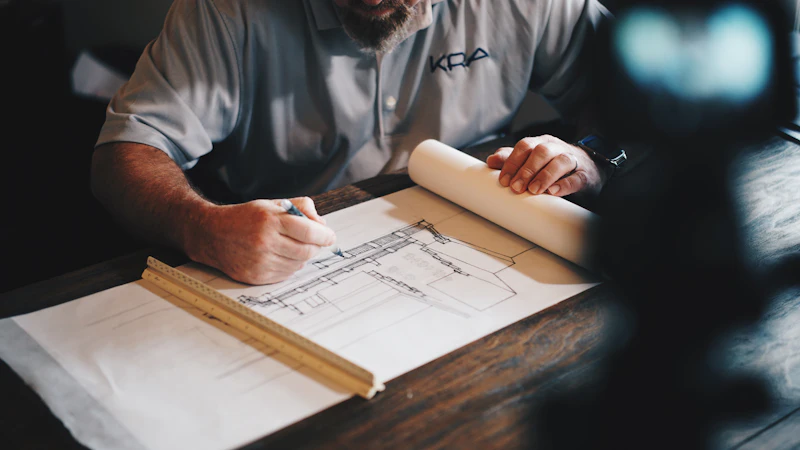
01.1. Plan the brief, not the design
Clients arrive at the first meeting with Pinterest boards. Beautiful, useful, but not the brief. The brief is: how many people, doing what kind of work, with what client-visit frequency, on what move-in deadline, with what budget band, with what 18-month growth horizon, with what compliance constraints.
Spending two hours on the brief upfront saves two months of design iteration later. We always insist on this conversation before the first 3D render.
The brief checklist we use
- Headcount today and 18-month horizon by function
- Client-visit volume and visitor profile
- Hard handover date (lease start, branch opening, term calendar)
- Budget band — basic, standard, premium, signature
- Compliance needs — NABH, FSSAI, IS-code, fire NOC
- Site constraints — building type, age, floor plate, existing services
- Brand references — mood boards, brand guidelines, parent-company offices
- Sector-specific constraints — server room, dealing floor, clinical zones
02.2. Get a line-item BOQ on letterhead, not a per-sqft WhatsApp number
The single most expensive mistake clients make is accepting a per-sqft quote without a line-item BOQ. ₹2,500/sqft on WhatsApp becomes ₹3,400/sqft at month four when the "miscellaneous" lines start showing up.
A real BOQ has 80-200 line items with material brand and grade specified per line. Insist on it. If a firm refuses to share a BOQ before signing, they're either inexperienced or hiding something. We share BOQ templates with clients even before engagement — it costs us nothing and the transparency builds trust.
03.3. Respect the MEP coordination phase
Most projects don't slip at design or at execution. They slip at MEP coordination. The phase where electrical, HVAC, plumbing, networking, and fire-fighting drawings get reconciled with each other and with the architectural plan. Catch a clash here, fix it on paper; catch it on site, fix it expensively.
If your designer is rushing through MEP coordination to get to execution, slow them down. A week of careful MEP coordination saves three weeks of on-site rework.
04.4. Build a sample mock-up before bulk procurement
For any premium-band project, building a sample bathroom or sample cabin before bulk procurement is the cheapest insurance available. 3-5% extra cost, saves 15-30% in avoided redos.
What goes into the sample: real finishes, real fittings, real joinery. The client walks through the sample, sits in the sample chair, checks the bathroom tap pressure, notices the joinery detail. Anything they don't like gets fixed in the sample, before the same mistake gets replicated across 30 rooms or 12 cabins.
05.5. Insist on a written change-order process
Every project has scope changes. Late-stage additions, design tweaks, material upgrades. The discipline that separates good firms from bad: every change goes through a written change-order with revised cost and schedule impact, signed before work proceeds.
Without this discipline, change requests become disputes at invoice time. With it, both sides know exactly what was added and what it cost. We have a one-page change-order template — every change, no matter how small, gets one.
06.6. Plan for compliance from concept, not at handover
NABH for healthcare. FSSAI for F&B. IS-code for industrial. Fire NOC for everything. BBMP/AMC for any structural change. SEZ accreditation for tech parks. All of these are designable-around from concept, retrofittable from handover at 3x the cost.
If your designer says "we'll handle compliance at the end," walk away. The right answer is "compliance is in the BOQ from week one, designed into the layout, and drawings are prepared in inspector-accepted format."
07.7. Schedule around reality, not the calendar you wish
Monsoon happens. Festivals happen. BBMP processing time happens. Material lead times happen. Schedule the project assuming these happen, not assuming they won't.
For Bangalore: pre-monsoon civil work, monsoon-window fit-out (covered), post-monsoon finishes. For Ahmedabad: schedule around Diwali and Uttarayan. For pan-India: account for vendor festival shutdowns in October-November and March-April.
08.8. Insist on weekly reviews with photo updates
The single best predictor of a project staying on track is a disciplined weekly review with photo updates. Not "we'll send you photos sometimes" — formal weekly review with structured agenda, photos, and a written status summary every Friday.
Our standard agenda: progress vs plan, this-week milestones, next-week milestones, blockers, change requests, financial status. 30 minutes, every week, without fail. The discipline matters more than the agenda.
09.9. Get 12-month defect liability in writing
Standard practice for serious commercial fit-outs: 12 months defect liability on civil and MEP workmanship, with the same site team that built it picking up the defect calls. Anything less is suspicious.
What "12-month defect liability" should actually mean: snags reported within 12 months get fixed within 5-10 working days, with the same site supervisor walking the snag, by the same trade workers who originally installed it. Not a different vendor coming in to fix mystery defects.
10.10. Don't confuse a decorator with a designer
Final big one. For any commercial brief that involves partitions, MEP, BOQ preparation, compliance, or execution oversight — you need a designer, not a decorator. Beautiful mood boards don't replace MEP coordination drawings. A great aesthetic sense doesn't replace fire NOC handling.
The questions to ask: in-house MEP engineers? Sample BOQ on letterhead? Fire NOC handling experience? Formal change-order process? 12-month defect liability with same site team? If a firm can't answer all five clearly, they're a decorator with design ambitions. Hire them for furniture-only briefs, not full fit-outs.
For a deeper dive on this distinction, the designers vs decorators piece walks through it in more detail.